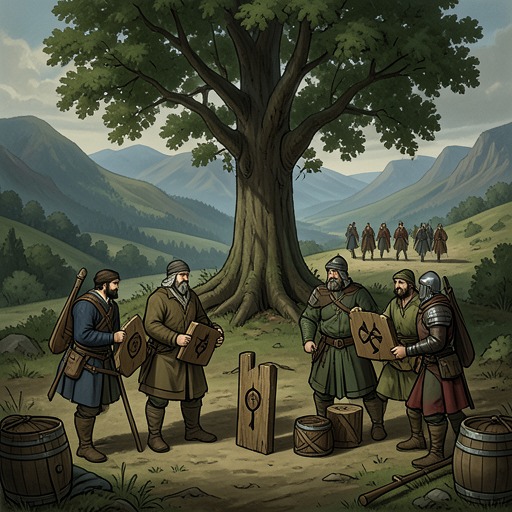
Rudenz Frees the Serfs
William TellRudenz Frees the Serfs is the public declaration in which Ulrich von Rudenz ends serfdom on his lands. Spoken at the drama’s close, the act makes the new freedom more than a rejection of foreign tyranny: it changes the relation between a lord and the people subject to his authority, while Bertha of Bruneck’s offer of her hand places their future together on the same footing of liberty.
Political Background
The declaration follows a conflict over what political obligation permits. The people recall that they freely sought the empire’s protection, and that their traditional duty included aiding it with their swords in war. Werner Stauffacher observes that even the freest people may have a feudal lord, but argues that this need not justify unlimited rule. The aim voiced in the assembly is to shake off hated thraldom and preserve ancient rights; Walter Furst insists that they will do what necessity demands, but nothing beyond it. Against this argument, Rudenz’s final act reaches into the social order within his own lands: freedom cannot mean only expelling oppressive governors while leaving his serfs bound.
The Declaration and Bertha’s Offer
In the closing exchange, Bertha offers her hand to Rudenz and names the terms of their union: “A free Swiss maiden to a free Swiss man!” Rudenz answers with a declaration of his own: “And from this moment all my serfs are free!” Its scope is explicit—all his serfs—and its timing immediate. The words do not describe a gradual reform or a future promise; they announce that his dependants’ status changes from that moment. The paired declarations connect personal commitment with political change without making them identical: Bertha offers herself freely, while Rudenz relinquishes the power to hold others as serfs.
Public Ending and Meaning
The announcement belongs to a crowded, celebratory ending. Peasants pledge their lives and fortunes; music follows, and the curtain falls. The liberation is therefore presented not as a private concession but as part of a publicly witnessed settlement. Earlier, the cap displayed at Altdorf had been identified as an instrument of despotic authority. After the building is attacked, Walter Furst argues that the cap should be preserved rather than burned: once an instrument of despots, it can become a lasting symbol of freedom. Girls bring it in on a pole as the stage fills with people. The changed meaning of this emblem accompanies the changed meaning of Rudenz’s authority: both are turned away from coercion and toward a shared account of freedom. His emancipation of the serfs gives the drama’s final liberty a concrete social consequence, while the fall of the curtain fixes the declaration as part of the community’s new beginning.